Intel
3 hours agoNews Editor

Intel’s 29% plunge hits tech stocks as markets turn to U.S. midterms and Apple earnings

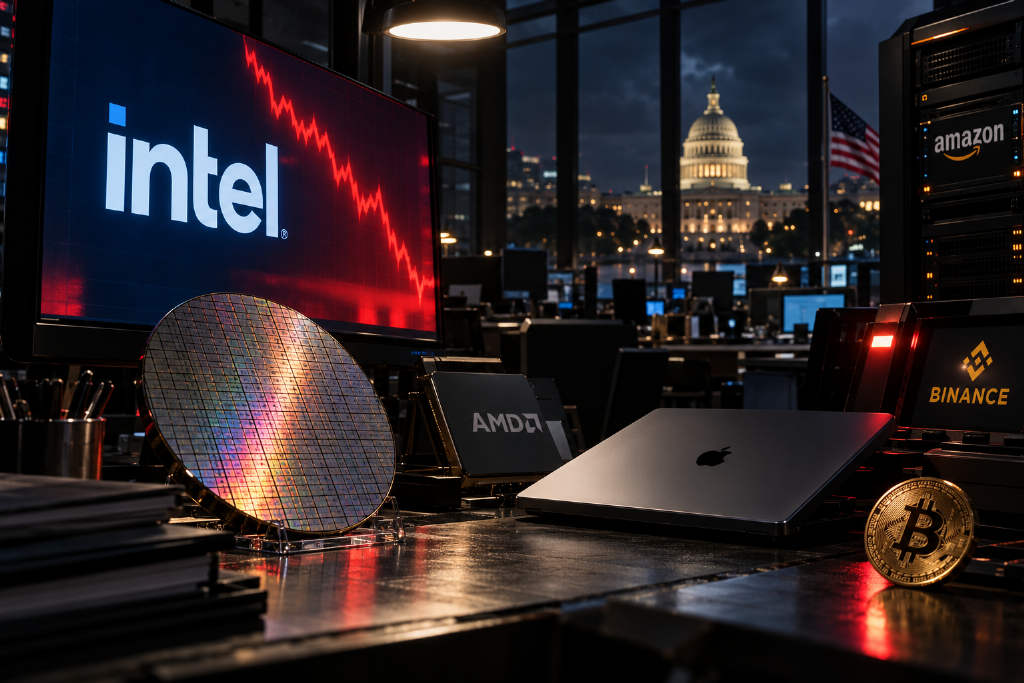
Intel led a sharp sell-off in U.S. technology shares after issuing fourth-quarter guidance that came in well below market expectations, sending the stock down 29% in its worst single-day drop since 1974. The move dragged the Philadelphia Semiconductor Index down more than 7% and helped push the Nasdaq to its biggest one-day decline since June. Amazon also weighed on sentiment. While Amazon Web Services posted 39.3% revenue growth and reached $46 billion in quarterly sales, investors focused on the company’s $77.3 billion in capital expenditures, which exceeded its $42.4 billion in operating cash flow, leaving free cash flow under pressure. Crypto markets were hit by a separate shock after Binance confirmed a major security breach with estimated losses of about $6.3 billion. Bitcoin briefly fell to around $76,300, while ETH and BNB also dropped and liquidations topped $1.6 billion across the market. The week ahead is now centered on several catalysts: Apple and Palantir earnings on Monday after the close, the U.S. midterm elections on Tuesday, AMD earnings later that day, and the U.S. October nonfarm payrolls report on Friday. Investors are also watching ISM manufacturing and services data for fresh signals on inflation and growth.

190
Intel’s 29% plunge hits tech stocks as markets turn to U.S. midterms and Apple earnings
CITIC Securities
3 hours agoNews Editor

CITIC Securities sees room for a rebound in U.S. tech stocks after the midterm elections

CITIC Securities said in a research note that U.S. technology stocks have been swinging with rapid shifts in the AI narrative since the second half of 2026 began, while transmission from bond credit default swaps, or CDS, to equity prices has also added to short-term volatility. The note said the decline in U.S. semiconductor hardware shares since early October has broadly remained in line with the market’s trading logic seen since mid-June. In its view, the bigger sources of pressure have come from macro liquidity stress and uncertainty tied to the midterm elections, rather than a temporary turn toward pessimism in the AI narrative. With major macro and industry disruptions over the past one to two weeks easing and a phase of more optimistic AI sentiment returning, CITIC Securities said it sees the possibility of a rebound in U.S. technology stocks after the midterm elections. The firm named semiconductor hardware as its top area of focus. The item was cited by Odaily and attributed to Jin10.

120
CITIC Securities sees room for a rebound in U.S. tech stocks after the midterm elections
US stocks
4 hours agoNews Editor

U.S. stock futures edge higher as markets watch midterm elections and nonfarm payrolls

U.S. stock index futures moved modestly higher ahead of Sunday trading after a weak week for major benchmarks, with investors turning their attention to a packed calendar that includes big-tech earnings, the October nonfarm payrolls report, and the U.S. midterm elections. S&P 500 futures rose 0.3%, Nasdaq 100 futures added 0.4%, and Dow Jones Industrial Average futures gained 116 points, or 0.2%. The rebound follows a sell-off in technology shares tied to concerns over heavy artificial intelligence infrastructure spending and the pressure it has placed on free cash flow. According to the report, recent earnings from major cloud service providers showed continued increases in AI-related capital expenditure. Amazon and Alphabet were cited as seeing free cash flow turn negative or deteriorate sharply, prompting closer scrutiny from Wall Street over when large AI investments may translate into revenue and profit. Last week, the Nasdaq Composite fell 2%, while the S&P 500 and Dow both kept weekly losses to less than 1%. In October, the Dow rose nearly 2% as capital rotated into defensive sectors such as healthcare. Markets are now looking to Tuesday’s midterm elections, Friday’s jobs report, and upcoming earnings from Apple, McDonald’s, and Qualcomm for clearer direction.

10
U.S. stock futures edge higher as markets watch midterm elections and nonfarm payrolls
Morgan Stanley
13 hours agoNews Editor

Morgan Stanley says U.S. stocks are a buy on dips regardless of midterm election outcome

Morgan Stanley’s chief U.S. equity strategist Mike Wilson said U.S. stocks could face several near-term pullback risks, including the U.S. midterm elections, market concerns tied to artificial intelligence spending, and liquidity constraints. He said those factors could push the S&P 500 down about 9% from its recent record high to 7,100. Even so, Wilson said such a decline would create a buying opportunity rather than change his broader view on equities. He expects the index could later climb to 8,000 once those risks are absorbed. Wilson also pointed to historical performance, saying that since 1950, U.S. stocks have risen in every six-month and 12-month period following midterm elections. Based on that pattern, he said investors should buy U.S. equities on weakness no matter how the election turns out, according to Bloomberg.

30
Morgan Stanley says U.S. stocks are a buy on dips regardless of midterm election outcome
Morgan Stanley
13 hours agoNews Editor

Morgan Stanley’s Mike Wilson warns of short-term U.S. stock pullback, keeps buy-the-dip call

Bloomberg reported that Mike Wilson, Morgan Stanley’s chief U.S. equity strategist, sees several near-term risks for the U.S. stock market. He pointed to the U.S. midterm elections, investor concerns tied to artificial intelligence spending, and liquidity constraints as factors that could trigger a short-term correction. Wilson said those pressures could pull the S&P 500 down about 9% from its recent record high to 7,100. Even so, Wilson did not frame the move as a lasting bearish turn. He said such a decline would create a buying opportunity and expects the S&P 500 could later climb to 8,000 once those risks are absorbed. He also cited historical performance, saying that since 1950, U.S. stocks have risen in the six months and 12 months following every midterm election. Based on that pattern, Wilson said investors should buy U.S. equities on dips regardless of the election outcome.

10
Morgan Stanley’s Mike Wilson warns of short-term U.S. stock pullback, keeps buy-the-dip call
Nomura
14 hours agoNews Editor

Nomura says the midterm vote won’t stop the tech selloff; only a Fed pause can

Nomura strategist Naka Matsuzawa says investors are putting too much weight on the U.S. midterm elections as a possible turning point for global technology stocks. In his Oct. 30 macro strategy weekly, he argued that the election outcome is far less important than many in the market assume, and that the only catalyst with the potential to truly end the sector’s decline is a halt to Federal Reserve rate hikes. Matsuzawa expects U.S. equities to trade soft in the week of the Nov. 2 vote, with bonds stronger, the dollar weaker and the yen firmer. He says the pressure on tech is tied less to election uncertainty and more to two deeper forces: strain on the outlook for AI investment and persistent credit concerns. He also argues that the recent rebound in semiconductor shares lacks both breadth and durability, making it unlikely to lift the broader global tech complex. The report also points to cross-asset signals. Matsuzawa says easing credit worries this week were more likely driven by lower U.S. rate-hike expectations than by improved confidence in tech companies’ financing capacity. He adds that if the next U.S. jobs report comes in stronger than expected, it could revive Fed tightening expectations and reignite credit stress. On currencies, he says dollar and yen moves are still being shaped heavily by credit sentiment.

10
Nomura says the midterm vote won’t stop the tech selloff; only a Fed pause can
macro
22 hours agoNews Editor

Next Week’s Macro Calendar Puts U.S. Payrolls, Midterm Elections and Big Tech Earnings in Focus

Markets are heading into a packed week after investors spent the past several sessions focused on questions around returns on AI capital spending, the Federal Reserve’s hawkish hold, and a sharp pullback in precious metals, according to Jin10, as cited by PANews. In equities, AI-related trades faced another round of selling pressure. In commodities, spot gold settled at $3,876.89 per ounce on Friday and fell 6.7% over October, while silver closed at $49.13 per ounce with a monthly decline of more than 18%. The coming week’s macro schedule includes the 2026 U.S. midterm elections on Tuesday, eurozone inflation data on Wednesday, the U.S. September trade balance and Treasury quarterly refunding announcement later that day, and U.S. services activity readings from S&P Global and ISM. Thursday brings eurozone September PPI and weekly U.S. jobless claims. On Friday, markets will watch remarks from New York Fed President John Williams and European Central Bank Chief Economist Philip Lane, followed by the U.S. October unemployment rate, nonfarm payrolls, hourly wage data, and preliminary University of Michigan consumer sentiment and one-year inflation expectations for November. Earnings will also be a major theme. More than 100 S&P 500 companies are set to report next week. LSEG IBES data shows that more than half of the index has already reported, with third-quarter earnings growth expected to reach 31.6%. Apple is scheduled to release results after the U.S. market close on Monday Eastern Time, while AMD and Qualcomm are also due to report next week.

50
Next Week’s Macro Calendar Puts U.S. Payrolls, Midterm Elections and Big Tech Earnings in Focus
Axios
1 days agoNews Editor

Axios: Trump may be more inclined to launch military action against Iran if Republicans lose midterms

According to Axios, a U.S. official said Donald Trump could become more inclined to order large-scale military action if Republicans suffer a heavy defeat in the midterm elections. The official said Trump tends to take bold action when he feels embarrassed or stripped of power, adding that this message has been conveyed to Iran and that now is the best time for Tehran to reach a deal. A White House official, however, said the election outcome would not affect Trump’s decision-making on Iran. The report was cited by Odaily, which attributed the item to Axios and Jin10.

80
Axios: Trump may be more inclined to launch military action against Iran if Republicans lose midterms
Total 74 items
Go topage